Career
From 3D Animator to Unreal Engine Technical Artist: my career pivot
I've spent more than eleven years animating characters. Eleven years bringing White Walkers, red-jacketed frogs and rag dolls jumping between platforms to life. And at some point along the way, without quite planning it, I started spending more time inside Unreal Engine than inside Maya. This is the story of that shift — and why I wouldn't call it "leaving animation," but rather the opposite.
Eleven years bringing characters to life
I started out in 2014 as a freelance 3D animator, working across series, video games and audiovisual projects for studios all over Europe. I animated White Walkers for Game of Thrones, characters for Happy! in Glasgow and London, entire seasons of Pocoyó, and the playable character in Sackboy: A Big Adventure.
Every project was different, but the craft underneath was always the same: understanding timing, weight, the intention behind a movement — making something made of polygons feel alive.
My work ended the moment the character was animated. From there, other teams took care of rendering and compositing — a process I know closely, but one that was never mine.
That craft of animating hasn't changed. It's still the foundation of everything I do today. What changed was where that work comes to life.
The curiosity that changed everything
My curiosity about Unreal Engine started while working on Sackboy: A Big Adventure. That's where I discovered it for the first time, and where something clicked: when the project wrapped, I didn't want to leave it there — I wanted to keep learning.
I signed up for a game development course using Unreal Engine and C++. I've forgotten a lot of the specifics of that course by now, but it helped me truly understand how the program works under the hood: Blueprints, logic, programming. It was the technical foundation I was missing.
The Unreal Fellowships: the missing piece
With that technical foundation already in place, in 2022 and 2023 I did Epic Games' Unreal Fellowships — first Storytelling, then Animation.
That's where I learned to use Unreal Engine with an artistic eye, not just a technical one: how a serious production pipeline is structured, how a technical team thinks, what best practices separate a project that works from one that breaks during its first live broadcast.
It was the missing piece that let me bring both worlds together: the animation and storytelling foundation I already had, combined with the technical side I'd learned on my own. That's where the hybrid I am today was born.
And of course, none of this happened overnight. It was a gradual process, not a change from one day to the next.
MR Factory: where animation and engineering meet
Since 2024 I've been working at MR Factory, part of Mediaset/Telecinco, as a Technical Artist. The day-to-day there looks nothing like my previous years:
- VFX and fluid simulations
- Materials and shaders
- Functional Blueprints for very specific production needs
- Rigging and asset preparation
- Scene optimization to keep everything running in real time without frame-rate drops
- Integrating Unreal Engine with broadcast systems like Vizrt and Viz Arc
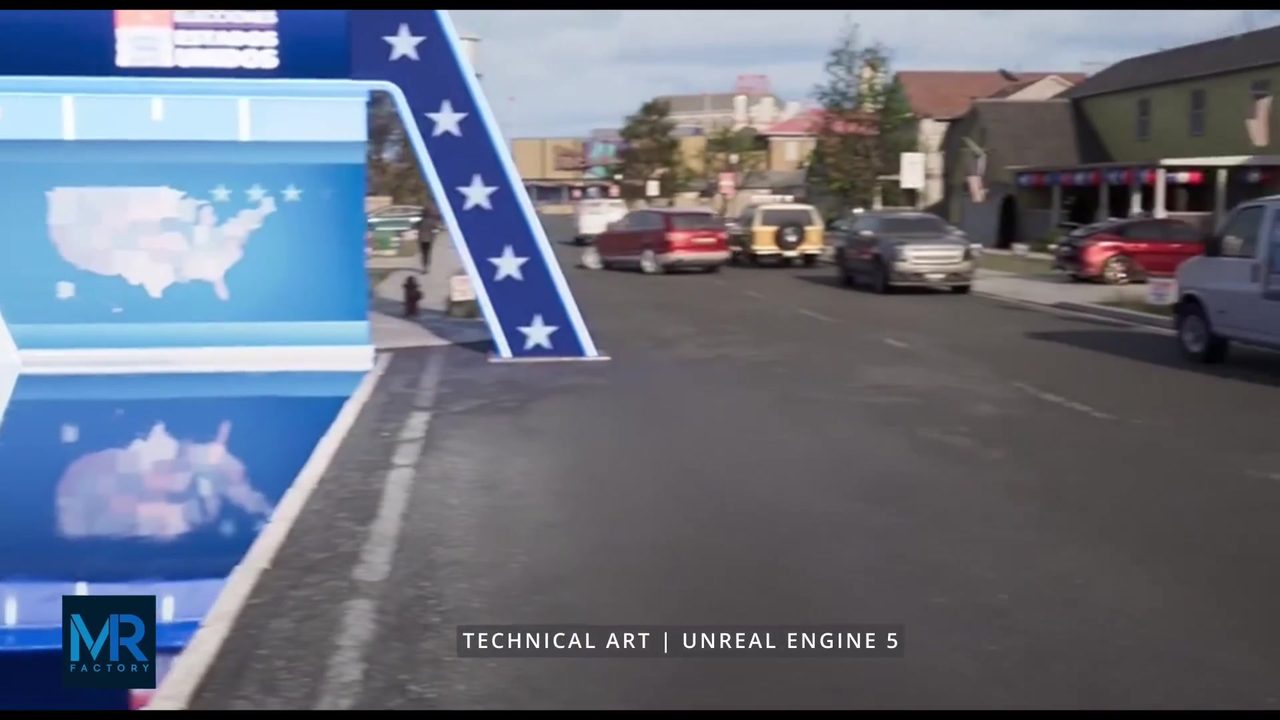
It's a context that doesn't forgive theory. A live news broadcast doesn't wait for you to finish debugging a Blueprint — if something fails, it fails on screen, live, in front of thousands of viewers. That pressure, oddly enough, is what I enjoy most about this second half of my career: it forces you to find practical, well-executed solutions, fast, with no room for unnecessary flourishes.
What an animator brings to a technical team
I didn't stop being an animator to become a programmer. I'm still, above all, someone who understands timing, weight and storytelling — I just apply that to technical decisions now too.
A Technical Artist coming purely from a technical background can solve a Blueprints problem flawlessly and still have the result feel "dead" on screen.
An animator who understands Unreal Engine also knows when a virtual camera move feels natural, when a cloth simulation reads well against a character's performance, or when a live transition needs half a second more of breathing room so the cut doesn't show. That sensibility isn't learned in a programming course — it's built by animating characters for years.
Is the jump worth it?
If you're an animator and the same curiosity I once felt is starting to itch, my short answer is: yes, it's worth it — but not as a replacement for what you already know how to do, as a new layer on top of it.
The fundamentals of animation and storytelling don't become less valuable in real time; if anything, that's where they show the most, because there's less room to fix everything in post-production.
What does change is how you work: you have to learn to think in systems, in performance, in how technical pieces talk to each other. But if you already know how to tell a story through a character, you're already halfway there.
Going through a similar pivot, or looking for someone who combines animation and Unreal Engine on your team?
Let's talk